
Passover A Story of Freedom, Faith, and Resilience: Celebrating Passover with JLW members
By: Dr. Amna Choudry
Edited by: Sarah Valerio
As spring blossomed in the nation’s capital, many members of the Junior League of Washington (JLW) gathered around their tables to celebrate Passover, the Jewish holiday commemorating the Exodus of the Israelites from slavery in Egypt. Rich with symbolism, storytelling, and spiritual reflection, Passover is more than just a holiday—it is a living legacy that speaks to hope, perseverance, and the enduring power of community.
This year, JLW is spotlighting reflections from two members—Diane Henner Berinstein, Sustainer, and Danielle Freedman, Tossed & Found Auction Co-Chair—who shared personal insights into what Passover means to them and how it continues to shape their lives and leadership.
The story of Passover is found in the Book of Exodus in the Torah and centers around the prophet Moses, who Jewish practitioners believe was chosen by God to lead the Israelites out of slavery. Pharaoh, the ruler of Egypt, refused to let them go, so the story tells that God sent ten plagues upon Egypt; the final and most devastating of which was the death of the firstborn sons. According to the Jewish faith, Jewish families were spared from this plague by marking their doorposts with lamb’s blood so the angel of death would “pass over” their homes—hence the name Passover.
To commemorate this event, Jewish people abstain from eating leavened foods and five species of grains (chametz) during the eight-day festival. Instead, they eat matzah, an unleavened flatbread, symbolizing the haste with which the Israelites fled Egypt—so quickly that their bread had no time to rise.
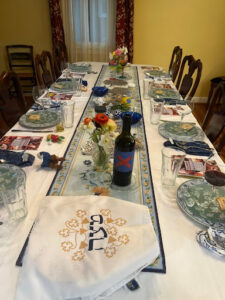
The Seder table before dinner. The Matzah for ritual purposes is at the head of the table. At the opposite end of the table are ritual glasses of wine for Elijah the Prophet and water for Miriam, Moses’s sister, who plays a significant role in the story of Passover. In the center of the table is the Seder plate with ritual items.
The Seder: Ritual and Reflection
At the heart of Passover is the Seder, a ceremonial meal held on the first two nights of the holiday. The word Seder means “order,” and the evening follows a specific sequence of rituals, readings, and symbolic foods, all aimed at retelling the story of the Exodus. Participants read from a book called the Haggadah, which guides the evening with prayers, songs, storytelling, and questions.
This retelling is sacred and deeply personal for Diane Berinstein, a JLW Sustainer. “It’s the ongoing story that connects us to our ancestors fleeing Egypt and becoming a nation,” she explains. “That’s always resonated with me—the notion that history can’t die as long as it is recounted to our people, our family.”
Each part of the Seder plate carries symbolism:
- Matzah: The unleavened bread of freedom.
- Maror (bitter herbs): The bitterness of slavery.
- Charoset (a sweet mix of fruits and nuts): The mortar used by enslaved Israelites.
- Karpas (greens): Renewal and hope, dipped in saltwater to recall tears.
- Zeroa (shank bone): The Passover sacrifice.
- Beitzah (egg): The cycle of life and mourning the loss of the Temple in Jerusalem.
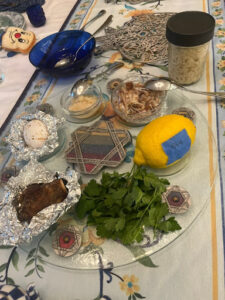
A Seder plate with the ritual foods, this year with the addition of a lemon. The egg, roasted bone, and lemon are symbolic and are not eaten, while the parsley, horseradish, and charoset (apples and nuts) are eaten.
Preparing for Passover: A Physical and Spiritual Journey
The lead-up to Passover is as significant as the Seder itself. It involves thorough cleaning of one’s home to remove any chametz and preparing special meals using kosher-for-Passover ingredients. For Berinstein, this is a deeply meditative time. She focuses on intention setting, focusing on themes of inequality, oppression, justice, and working towards a more equitable future through action. She says. “It’s a physical reminder of both the privilege and responsibility of being free.” The holiday emphasizes, “Themes such as the importance of freedom, justice, and self-determination. The Seder naturally encourages reflection and discussion on how these themes are present in our own world and how we in our own lives can intentionally undertake actions to bring about a world where there is greater peace, harmony, and safety for all,” states Berinstein. “At points in the Seder, we pause to remember that our joy is never complete when others are suffering, or were lost in the quest for freedom.”
Danielle Freedman, Co-Chair of Tossed & Found Auction, also finds inspiration in the season. “I never understood Passover as a kid. Now, as an adult, I see it as one of the most important stories of all time. It forces us to believe in faith in order to understand the present.”
Inclusivity at the Seder Table
Passover Seders are famously welcoming and inclusive. As Berinstein explains, “The Haggadah opens with a line, ‘Let all who are hungry come and eat. All those who are in distress come and celebrate with us.’” From young children to newcomers experiencing their first Seder, every voice has a place.
Freedman is equally passionate about ensuring her guests feel welcomed and seen. “I try not to make my celebrations too technical but rather more spiritual, so everyone can join and identify from their own experiences and perspectives.”
Traditions Old and New
Whether it’s the intense pre-holiday preparations, traditional foods, or the joyful chaos of a full Seder table, Passover traditions hold deep personal significance.
Berinstein describes how the process begins a month in advance, starting with the Jewish holiday of Purim. “I bake hundreds of Hamentaschen cookies with the goal of using up the flour, sugar, and baking powder… It’s a very meaningful way to appreciate the privilege we enjoy of being well sustained.”
In her home, favorites include matzah brei—savory matzah French toast—and flourless desserts that her kids have grown to love. “If anyone wants a recipe, just call! I can’t pick one!” she laughs.
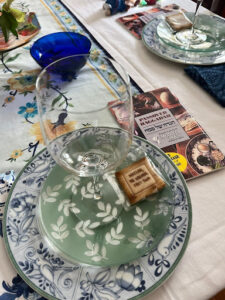
An image of a place setting at Berinstein’s table — with a typical American Haggadah. In 1932, Maxwell House Coffee began giving out free Haggadah’s with the purchase of coffee.
Carrying our Values into Community
Passover’s call to tikkun olam—the Jewish principle of repairing the world—resonates deeply with Berinstein’s decades of service in the Junior League. “Many of the values found in the Haggadah—welcoming the stranger, teaching and learning, and passing our values down through generations—are also reflected in JLW’s mission,” she shares. “Through volunteering, I’ve been able to live out those Jewish values, especially by reaching beyond my immediate circle to support and uplift others.”
Advice for First-Time Seder Guests
For those invited to a Seder for the first time, both women offer words of encouragement.
“Ask questions,” urges Berinstein. “Don’t come hungry—we’ll be telling the story for over an hour before the meal begins!”
“Enjoy it and soak it all up,” says Freedman. “There’s so much to learn, and how lucky are we to benefit from the blessing given to us by our brave ancestors.”
Passover is more than a holiday—it’s a legacy, a conversation, and a celebration of freedom that challenges us to reflect, be inclusive of others, and act with intention. Through storytelling, service, and reflection, JLW’s Jewish members remind us that honoring diverse traditions makes our League stronger.
Chag Pesach Sameach – Wishing a Joyous and Meaningful Passover to All Who Celebrate!