
JLW and Planet Word, Together Elevating Young Voices
By: Megan Lilly, Vice Chair of Blogs
Imagine being told your voice matters and having people actually listen.
That idea sits at the center of the partnership between the Junior League of Washington (JLW) and Planet Word, and it was the thread running through a recent conversation on the League of Extraordinary Women podcast episode featuring Planet Word Founder and CEO Ann B. Friedman and JLW’s Kate Miceli, Vice Chair of the Literacy Events Planning Committee.
What emerged from that discussion was more than a conversation about poetry; it was a reflection on language itself, who has access to it, who feels confident using it, and what can change when young people realize their words carry weight. Planet Word exists because Friedman believed language deserved its own space, not as a subject to study but as something to experience.
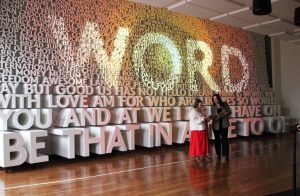
Kate Miceli, Vice Chair of JLW’s Literacy Events Planning Committee, and Barbara Kirwan, Vice Chair of Digital Media at JLW, at Planet Word’s Word Wall
After years of working as an educator and living abroad in cities shaped by division, Friedman returned to Washington determined to create something that could bring people together. The result is a museum unlike any other; it is a place where words are not static text but sound, movement, and interaction. Visitors do not just read language. They hear it, play with it, and step inside it. It is the kind of environment that reminds both kids and adults that language is not intimidating. It is alive.
That philosophy aligns naturally with the Junior League’s work across the D.C. community. Both organizations share a belief that literacy is not just an academic milestone. It is a form of confidence. It is a tool for connection. And sometimes it is the first step toward seeing yourself differently.
JLW’s annual Youth Poetry Contest is one expression of that partnership, but it reflects something larger: a shared commitment to making language feel welcoming, creative, and accessible for young people across Washington, D.C. For nearly three decades, the contest has invited students to experiment with language in ways that feel empowering instead of intimidating. This year’s theme, Imagine, seeks to capture that spirit. It does not ask students for the right answer. It asks what they see, what they feel, and what they think could be possible.
Open to students in grades four through eight attending eligible D.C. public, charter, Archdiocese, and approved after-school programs, the contest runs through March 27, 2026. Poems can take nearly any form and may be written in English or Spanish, as long as they are original work. Full details can be found here on the JLW website.
What makes the contest experience meaningful is not just recognition. It is the care built into the process. Each submission is reviewed thoroughly by trained Junior League members, and educators receive feedback for every participating student. Even those who do not place walk away encouraged, supported, and seen as writers. For selected students, the experience culminates in a celebration at Planet Word, where their poems are published in Capitol Cadences and read aloud in front of family members, teachers, and peers. Picture a young writer standing in a museum dedicated entirely to language, sharing words they wrote themselves while a room full of adults listens closely. Moments like that can stay with someone for years and change the trajectory of their writing ambitions.
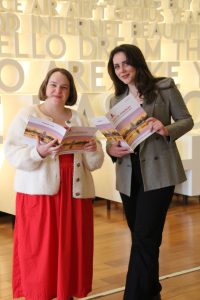
Miceli and Kirwan hold copies of Capitol Cadences, celebrating young poets across Washington, D.C.
This is the heart of the partnership. It is bigger than a single event. It is about what happens when organizations align around a shared belief that giving young people space to express themselves can change how they see their own potential. Literacy is often talked about in terms of benchmarks and scores. Poetry shifts that conversation. It invites curiosity. It rewards imagination. It teaches revision, patience, and confidence, skills that extend far beyond the classroom.
The Junior League of Washington and Planet Word understand that deeply. Their collaboration shows what is possible when community organizations invest not just in programs but in people, because when young voices are encouraged, supported, and truly heard, they do more than just write poems.
They begin to believe in the power of what they have to say.