
Ramadan and Eid
By: Ljubitca Fadic
The Junior League of Washington remains committed to fostering a community where members feel seen, valued, and included. As part of this commitment, we aim to celebrate the rich diversity within our League community by helping members better understand each other’s unique backgrounds. Amna Choudry, 2024-2025 Publications Chair, shares insights into the personal and spiritual significance of Ramadan and Eid, and discusses how these observances shape her sense of community and commitment to service.
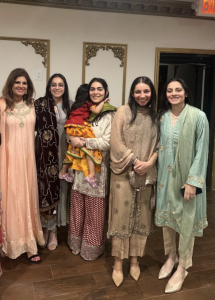
Amna Choudry, 2024-2025 Publications Chair and her loved ones during Friday night dinner.
The Significance of Ramadan
“Ramadan is one of the Five Pillars of Islam, central to our faith,” Choudry explained. “It’s a time for deepening our relationship with God through fasting, prayer, and charity.” For Choudry, fasting is both a physical discipline and a reminder of the struggles faced by the less fortunate, fostering empathy and gratitude. “It strengthens our connection to God and encourages us to focus on patience and generosity,” she said.
When asked about the most meaningful part of Ramadan, Choudry shared, “It’s the sense of community. I help coordinate volunteers who serve meals to mosque-goers, the homeless, and anyone in need. I love seeing people of all ages, especially children, come together to help. The unity and support we share during this time are incredibly fulfilling.”
Preparing for Ramadan
Preparing for Ramadan is an important tradition in Choudry’s family that brings her loved ones together. “We make meals like chicken tikka, kebabs, and samosas in advance for Suhoor and Iftar. My father, who helped build our first mosque, continues to contribute to its upkeep. We make sure everything is ready for the holy month.”
Choudry’s daily routine during Ramadan is shaped by a series of rituals throughout the day. “I wake up for Suhoor before dawn and pray. Then I join my family for a walk as the sun rises. In the evening, I volunteer at the mosque, helping prepare meals for hundreds of people. It’s inspiring to see the leadership roles that fellow community members take on.”
Though Choudry shares that fasting can be physically challenging, with irregular sleep patterns and long hours without food, she finds strength in prayer and the support of her community. “Fasting alongside millions of people worldwide keeps me motivated.”
Charity and Personal Growth
Charity plays a central role during Ramadan. “I use my talents to give back, whether by organizing, fundraising, or serving the community directly,” Choudry noted. Her personal community engages in both monetary donations and hands-on service, preparing meals for those in need. Choudry’s most memorable Ramadan moments include seeing teenagers and children volunteer for Iftar. “It was a full-circle moment for me, as I once helped organize Iftars as a child. It’s beautiful to see the next generation getting involved in community service.”

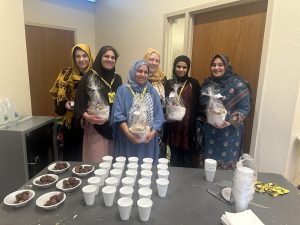
Choudry volunteering at her local mosque during Ramadan.
Eid
Eid al-Fitr marks the end of Ramadan. It’s a time of gratitude, reflection, and festivity, signifying the completion of a month of fasting and spiritual growth. “For my community and me, Eid is an opportunity to come together, strengthen our bonds, and celebrate our faith,” she shared. The day begins with prayer at the mosque, followed by greetings of “Eid Mubarak,” and a festive brunch with loved ones.
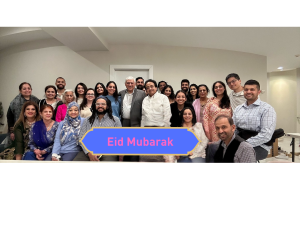
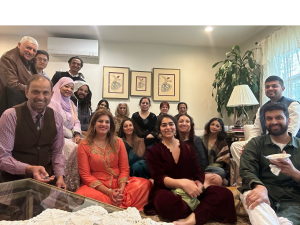
Amna celebrating the Eid tradition alongside her family and community.
Choudry’s traditions include wearing her favorite Pakistani clothes. “I love wearing intricately embroidered outfits in vibrant colors, often paired with matching accessories. It adds to the festive spirit and makes the day feel extra special,” she said. Following morning prayer, the day is spent with relatives, exchanging gifts, and enjoying meals together. Choudry particularly enjoys a community fair held during Eid, where members come together, fostering a sense of love and unity. “In Oklahoma, we have a United Eid prayer where thousands of Muslims from all over the state pray together,” Choudry said. “In NYC, this happens at Washington Square Park. Every year, I look forward to the laughter, the delicious food, and the joy of being with my community.”
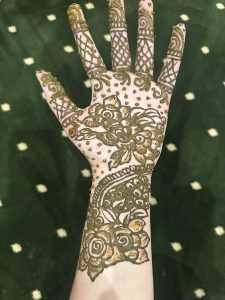
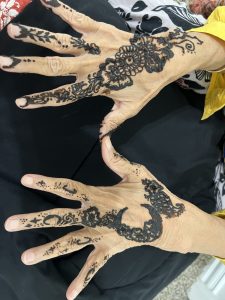
Close-up shots of intricate henna designs
Eid is also marked by a wide array of traditional dishes and treats. “We make halwa, gulab jamun, jalebi, and baklava, along with tons of biryani,” she noted. “I make amazing baklava!”
Among her favorite memories, Choudry recalls the year when her entire family gathered in upstate New York to celebrate Eid together. “Having everyone in one place made the occasion even more meaningful,” she reflected. “I also remember the excitement of Eid as a child, with new clothes and receiving Eidi (monetary gifts) from elders.” She also looks forward to Chaand Raat, the night before Eid, a special tradition that involves applying henna or Mehndi to celebrate the end of Ramadan.
After a month of fasting, she expressed joy at partaking in the celebratory meals of Eid. “The first sip of sweet sheer khurma [a traditional milk and vermicelli dessert] is always a delight,” Choudry said. “The day is filled with warmth, connection, and appreciation for the blessings we have.”
For Choudry, Eid is a time to come together with her community and reflect on the spiritual lessons of Ramadan. “While Eid is a time for celebration, it’s also a moment for gratitude,” she said. “The transition from Ramadan’s discipline to Eid’s festivities is a reminder to carry forward the lessons of patience, empathy, and generosity beyond the holy month.”